
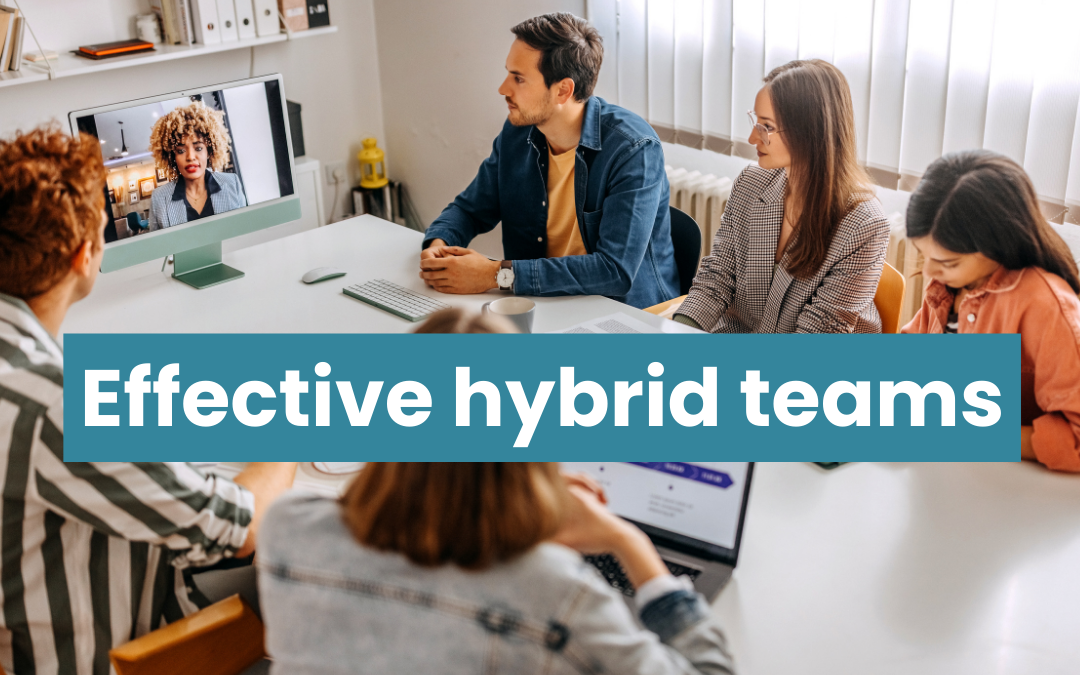
Three years after lockdown, the workplace is a very different environment. Fully remote or hybrid working models are the norm in many organisations.
Juggling the demands of an office-based and a remote workforce can be difficult for organisations. Recently, we’ve been contacted by organisations worried about disconnected online team members.
Our Leading Hybrid Teams with Ease course helps managers motivate and engage hybrid workforces. It has a particular focus on protecting the wellbeing of remote workers.
These tips may help if you’re struggling to engage your hybrid teams.
Key to successful hybrid working
Successful hybrid working has to be based on effective communication. Everyone should feel part of the team, regardless of where they’re sat. That means making sure that people
- Can contribute meaningfully to team meetings and events
- Feel connected to their colleagues
- Are acknowledged and rewarded for the work they do
- Feel supported when they’re going through difficult times
- Can keep effective boundaries between their work and home lives
Managing hybrid meetings
Once some team members are onsite, it’s easy to slip back into old ways of communicating, with a focus on in-person meetings.
Team members dialling into these meetings can feel left out and disconnected. Your hybrid meetings can go much more smoothly if you
- Ensure people at home can hear people in the room—ask speakers to sit close to the laptop or invest in microphones
- Use a big screen so that team members at home are visible to those in the room
- Rotate between hybrid meetings where some people are in the room and online meetings where everyone joins from their desk
- Keep checking with your online team members and asking for questions and input
- Regularly ask people how they feel hybrid meetings are going and implement feedback where you can
Improving connections between hybrid teams
Allow your hybrid teams time to goof off and chat. Many remote workers miss the opportunity to have fun with colleagues.
- Encourage staff to schedule in time to relax, chat and catch up with each others’ news
- Consider scheduling online tea-breaks and catch ups—but know that these may seem like ‘organised fun’
- Managers’ presence during online meetups can stymie fun—try reserving these for team members and asking for feedback
- Ask your team what would make them feel more connected, and don’t be defensive about the suggestions
Rewarding and motivating remote workers
Your team should feel trusted, not under suspicion. Good managers focus on outcomes and results, rather than on a person’s visibility or availability.
Your team members may feel more motivated and appreciated if
- You take their preferences onboard when asking how much contact time they want or need
- You notice the work they’ve done and thank them for it
- You highlight and reward their achievements
Supporting remote workers through difficult times
It can be difficult for managers to know how to best support someone going through a difficult time. It’s even harder when that person is working from home. Home-working setups can magnify your worries about intruding on someone’s privacy.
Remote workers can struggle with loneliness and motivation after trauma, loss or illness. They may feel isolated, unsupported and pressured to get back to normal.
You can support remote workers who have been through tough times by
- Finding out what they need and want from you, especially regarding what is shared with colleagues
- Letting them know what support is available—check your employee assistance programme
- Relaxing your expectations and removing some of the person’s responsibilities while they recover
- Keeping an eye on how they’re doing and looking for signs of distress—your first concern should be their wellbeing and not their output
Inspire provides training to help managers and team members cope with grief and loss.
Respecting boundaries for remote workers
Not everyone who works from home has the luxury of a home office. You may work from your kitchen, bedroom or living room.
Letting colleagues see the private spaces of your home life is a lot to ask. Some people will be reluctant to turn cameras on in meetings. For others, the lack of a defined workspace can blur the boundaries between work and home. They may feel as though they’re permanently on-call.
You can help to reinforce the boundary between work and home life by
- Talking privately to team members who don’t turn their cameras on—find out why this is
- Checking in with colleagues who appear to be working outside core work hours
- Developing agile or hybrid working policies that explain your approach to remote work
- Checking in with team members to see how they’re doing and focusing these conversations on wellbeing, not performance
The right support for your team
Whether it’s helping managers lead hybrid teams, supporting team members at difficult points in their lives or helping your organisation come up with a wellbeing strategy that works for remote workers, Inspire can help.
Contact your account manager or Tanya Neeson, our Business Development Executive to discuss your needs.
More from our blog
Menopause and work
The menopause is a natural biological process. It occurs when your ovaries age and naturally produce lower levels of reproductive hormones. The menopause may have a significant impact on home life and work performance. This can be unsettling, particularly if a particular role carries lots of responsibility. The hormonal changes…
Understanding Stepped Care and its role in workplace wellbeing
The stepped care model is a fundamental part of Inspire's workplace offering. So, what is it and why is it so important?

National Work Life Week
Finding Balance in a Busy World National Work Life Week takes place from 5-9 October 2026 and encourages people to reflect on how they can achieve a healthier, more sustainable balance between work and personal life. Every year, National Work Life Week encourages individuals and organisations to reflect on how…
World Mental Health Day
This month is an opportunity to notice how we support one another, challenge assumptions and create more inclusive spaces. By listening with empathy and staying open to different perspectives, we can all contribute to a kinder and more understanding workplace. World Mental Health Day, observed annually on 10 October, encourages…
World Gratitude Day
The power of appreciating what matters World Gratitude Day, celebrated annually on 21 September, encourages us to pause and recognise the people, experiences and opportunities that positively impact our lives. In today\'s fast-paced world, it\'s easy to focus on deadlines, demands and what\'s still left to do. Gratitude invites us…
World Suicide Prevention Day
World Suicide Prevention Day encourages people around the globe to raise awareness, reduce stigma and promote actions that can save lives. Suicide remains a significant public health challenge across the UK and Ireland. According to the latest available data, 5,717 suicides were registered in England in 2024, while Northern Ireland…
National Wellness & Happiness Happens Month
July invited us to pause. Through Alcohol Awareness Week and a focus on self-care, many of us took the opportunity to reflect, reset and make small changes – whether that meant becoming more aware of our habits, building in better routines, or simply taking a bit more time to look…
International Self-Care Day
In a world where busy often feels like the default, self-care can sometimes be misunderstood as a luxury – something we get to if we have the time. In reality, self-care is much simpler, more accessible, and far more essential than that. At its core, self-care is about consistently doing…

Alcohol and Me
Alcohol Awareness Week (6-12 July), returns this month with a simple but powerful focus: ‘Alcohol and me.’ Rather than telling us what we should or shouldn’t be doing, this year’s campaign is asking everyone to pause and reflect on their own relationship with alcohol, and how it fits into their…

PTSD Awareness Day
Trauma isn’t always dramatic or visible. In reality, it can come from things many of us experience at some point in life - not just rare or extreme events. It could be a car accident, losing someone suddenly, going through a serious illness, experiencing ongoing stress, or difficult experiences growing…

Men’s Mental Health Week
Every June, Men’s Health Week (15th to 21st) highlights a simple but powerful message: men’s health needs more attention - physically and mentally. While progress has been made, the reality across Ireland, the UK, and globally, is that men still experience poorer health outcomes and are less likely to seek…
World Day for Cultural Diversity
World Day for Cultural Diversity on 21 May celebrates the different cultures, identities, experiences and perspectives that shape who we are – and how diversity enriches our workplaces, communities and conversations.